One of the challenges in running a 3D printing and design business is describing what you can actually do. There are the obvious applications of prototypes, jigs, molds and fixtures but we are trying to expand the routine use of 3D printing outside of manufacturing. One application that, as a chemist, I find fascinating is creating molecular structures from crystallography data.
Most people are familiar with the “tinker toy” molecular models which give average bond angles and distances and are useful to a point. However, many interesting molecules deviate significantly from these averages and the deviations are important. Chemists generally rely on 2D representations on a computer display to look at molecules but a 3D molecular model allows you to see things that are hard to pick up on a screen. This is particularly true for students who are first trying to visualize molecules in 3D.
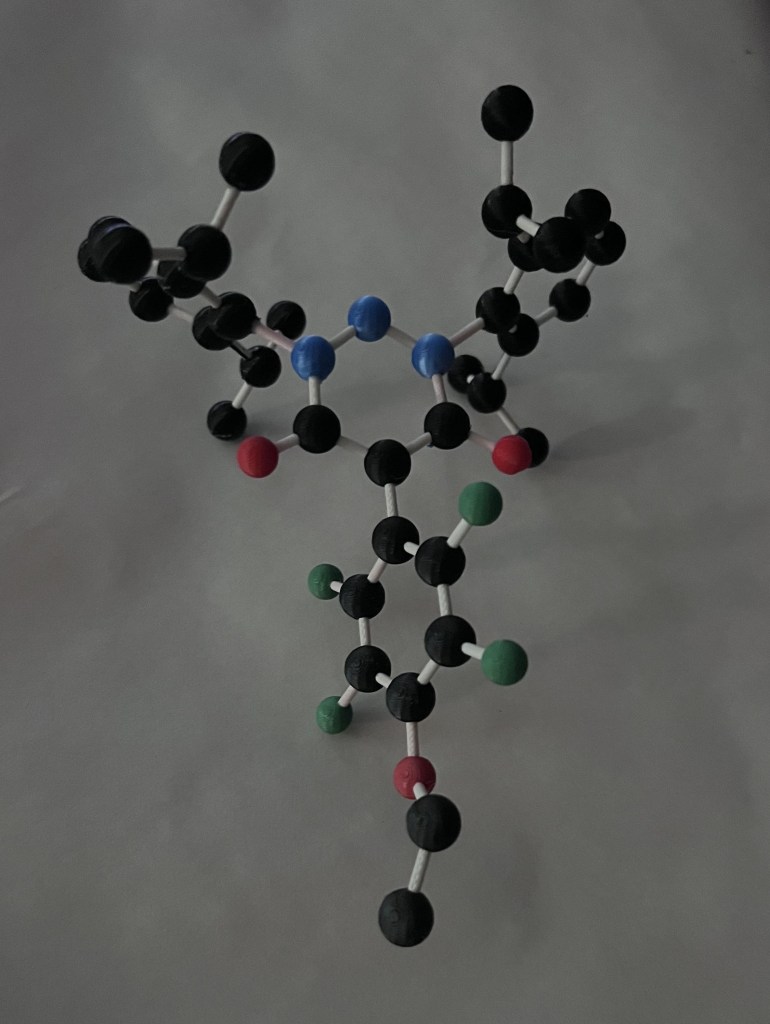
Printing molecular models is certainly not new. As soon as desktop 3D printers became available, chemists started experimenting with printing models. At FNW3D, we want to make these models available to anyone, whether you know anything about 3D printing or not. As an example, the model shown below is based on data recently published by Randia et. al. in Angew. Chemie. (DOI e3083427) and highlighted by the CCDC on LinkedIN. It is a very unusual stable, N-centered radical anion. It was printed in 5 colors on a Prusa i3 Mk4 with the MMU3 attachment. For convenient printing, the two diisopropylphenyl groups were printed separately so some molecular modeling was required. We can print this model for <$75.
This exemplifies the kind of work we do in FNW3D which requires field expertise (in this case, chemistry), CAD skills and a fairly sophisticated knowledge of 3D printing. If you’re interested, please get in touch!


Leave a comment